Technically proficient problem-solver with 15+ years in tech and 10 in customer service — building, fixing, and supporting everything from PCs and embedded systems to websites and Discord bots. I believe technology should be accessible to everyone.
I've been into technology for over 15 years. I've built more PCs than I can count, and I'm the person friends, family, and coworkers call the moment something won't turn on. From embedded systems and 3D-printed designs to websites and Discord bots, I love making things — and I'm always learning.
With 10 years in customer service, I love working with people just as much as I love tech. Whether it's fixing a problem, designing something new, or just helping out however I can, I'm at my best bridging the gap between complex systems and the people who use them. Right now I'm going deeper into AWS — from hosting this very site on S3 and CloudFront to disaster recovery, backups, and system resilience.
15+
Years in technology
10 yrs
Customer service
$250K+
RMAs deflected at Newegg
A+
CompTIA Certified
Meet Stuart — He's So Chill
My tiny black Chihuahua and resident relaxation expert.
Computer ScienceCybersecurityIT — Fullerton College
03 — Experience
Where I've worked
2025 — Present
PC Support · Sales & Enterprise Support
Newegg — Diamond Bar, CA
Deflected over $250,000 in RMAs by troubleshooting PC hardware in my first 6 months.
Provided technical support for customers with PC hardware, software, and peripheral issues.
Coordinated sales of enterprise and server components, bridging customer inquiries to the in-house server team.
Documented customer interactions and technical findings to maintain accurate support records.
2024 — 2025
Mathematics Tutor
Fullerton College — Fullerton, CA
Tutored students across multiple levels of mathematics with personalized, one-on-one support.
Tailored explanations to match each student's learning style and built their confidence.
2022 — 2025
Customer Service · Cashier
Panda Express — La Habra, CA
Handled orders efficiently while creating a welcoming experience through friendly, personalized service.
Adapted quickly to unexpected challenges during peak hours while keeping team coordination smooth.
2016 — 2022
Customer Service · Kitchen Team
Chick-fil-A — City of Industry & Puente Hills, CA
Delivered fast, friendly service while building strong connections with customers and teammates.
Thrived in a fast-paced environment with a focus on quality and consistency.
04 — Projects
Things I've built
A mix of freelance work, hardware experiments, and side projects.
★ Featured Build
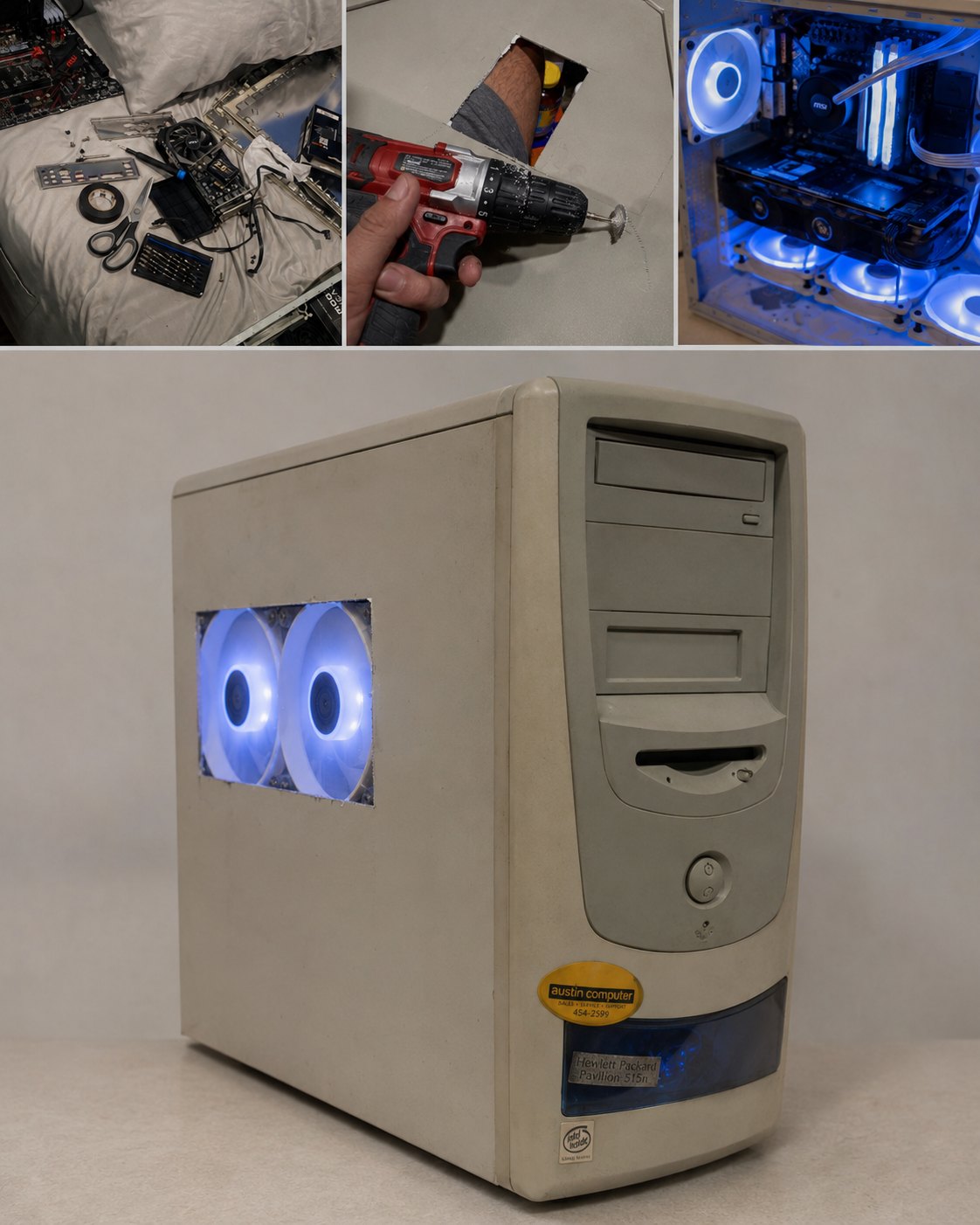
1997 HP Pavilion "Sleeper" PC
Flagship modern internals hidden in a vintage chassis
I started with a clear vision but without many of the proper fabrication tools. Instead of letting that stop me, I worked with what I had, adapted along the way, and committed to making the concept real — a fully modern gaming rig built inside an unassuming 1997 HP Pavilion case. The mods aren't factory-perfect, but they represent persistence, creative problem-solving, and turning an idea into a working final product.
CPU Intel Core i9-9900K
Board MSI Z390 Gaming
GPU NVIDIA RTX 2080
PC BuildingCase ModdingFabrication
★ Featured Build
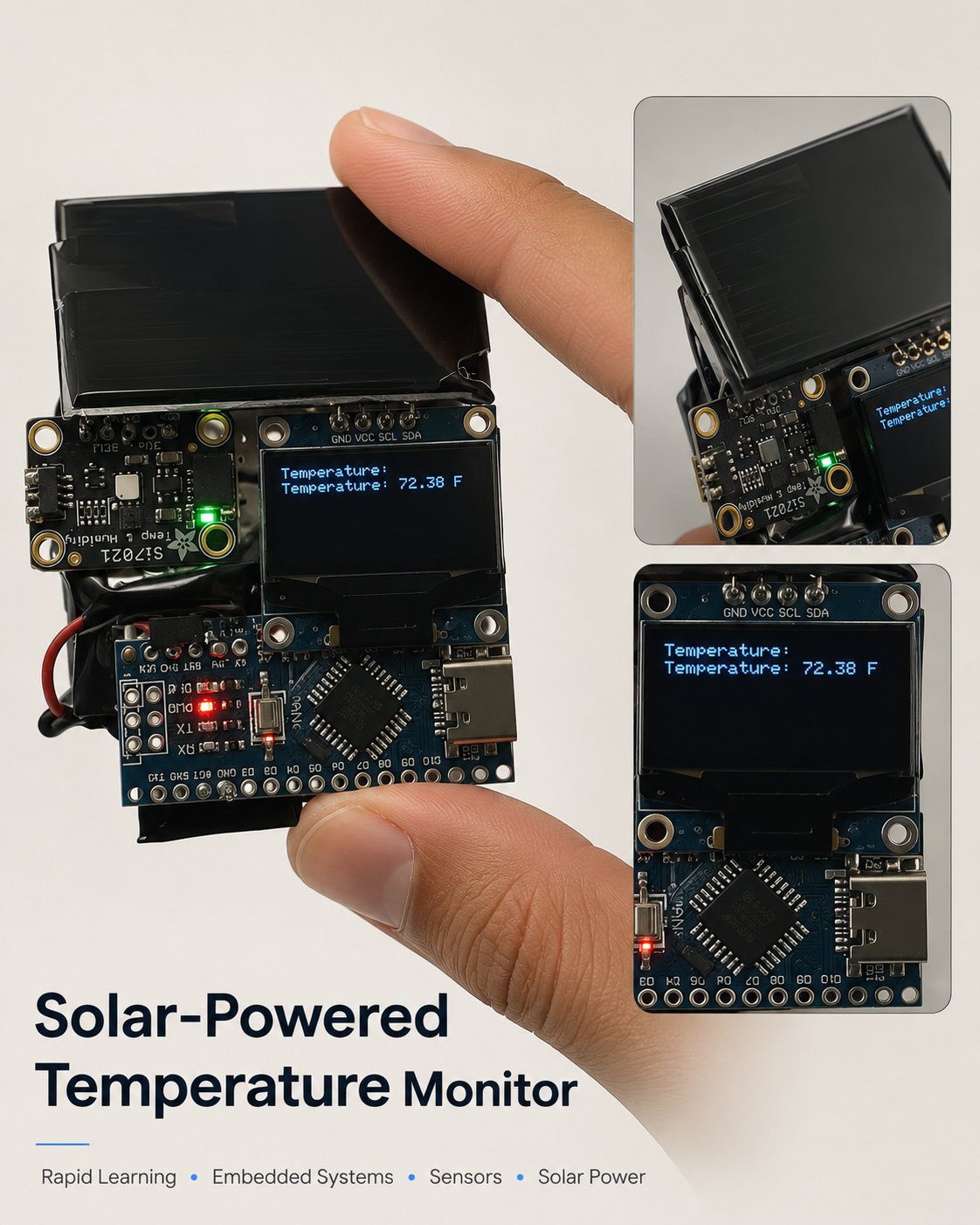
Solar-Powered Temperature Monitor
From blinking an LED to a working device in about a week
This project captures how I learn when something genuinely grabs me — I immerse myself completely and push to learn fast. In roughly a week, while balancing full-time school and work, I went from basic LED control to a functional solar-powered temperature monitor. What started as simple experimentation became a deeper dive into embedded systems, sensors, and power management — proof that I can become deeply engaged, learn rapidly, and turn curiosity into a working result.
Sensor Adafruit Si7021
Display OLED I²C
Power Solar + LiPo
Rapid LearningEmbedded SystemsSensorsSolar Power
★ Featured Case Study · UX & Process Design
Newegg PC Support — Redesigning the Customer Support Journey
Turning frontline support insights into customer-experience and internal-process improvements
I work frontline in Newegg's PC Support — troubleshooting hardware, answering compatibility questions, handling returns, and helping customers choose the right parts. Talking to customers all day, I kept hitting the same friction that isn't obvious from a pure web-design view: people unsure where to even start for help, technical information scattered across product listings, support pages, and manufacturer docs, and assisted sales that were never credited back to the agent who guided them. So I approached it as both a support rep and a UX designer — turning real support patterns into a connected set of design concepts, prototypes, and proposed workflows for internal review and demos.
Frontline support insight → recurring problem patterns → design concepts & prototypes → internal demos & iteration
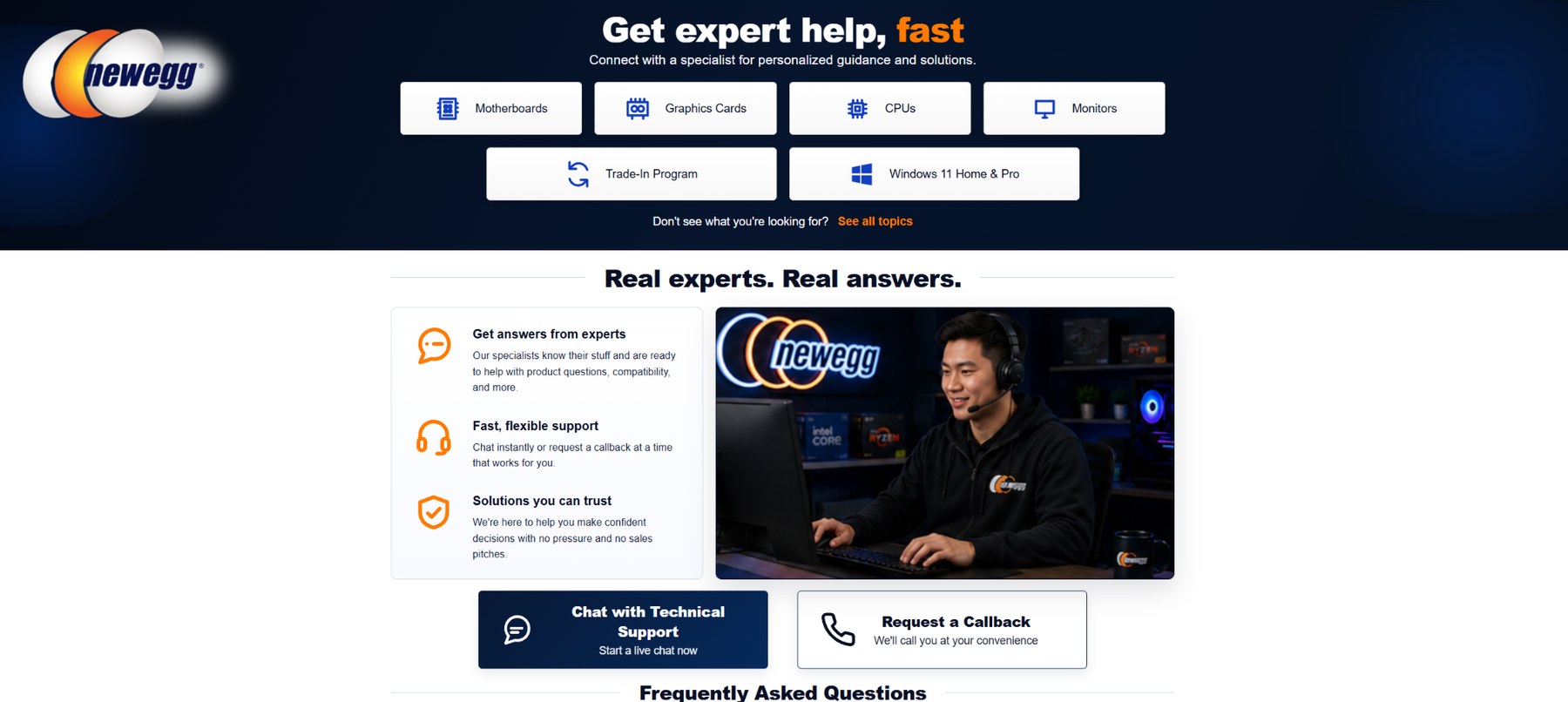
01Support Landing PageTwo clear entry points — live chat or request a callback — so customers stop guessing where to begin.
02Callback WorkflowCustomers pick a callback window instead of waiting in queue; agents get issue context before they dial.
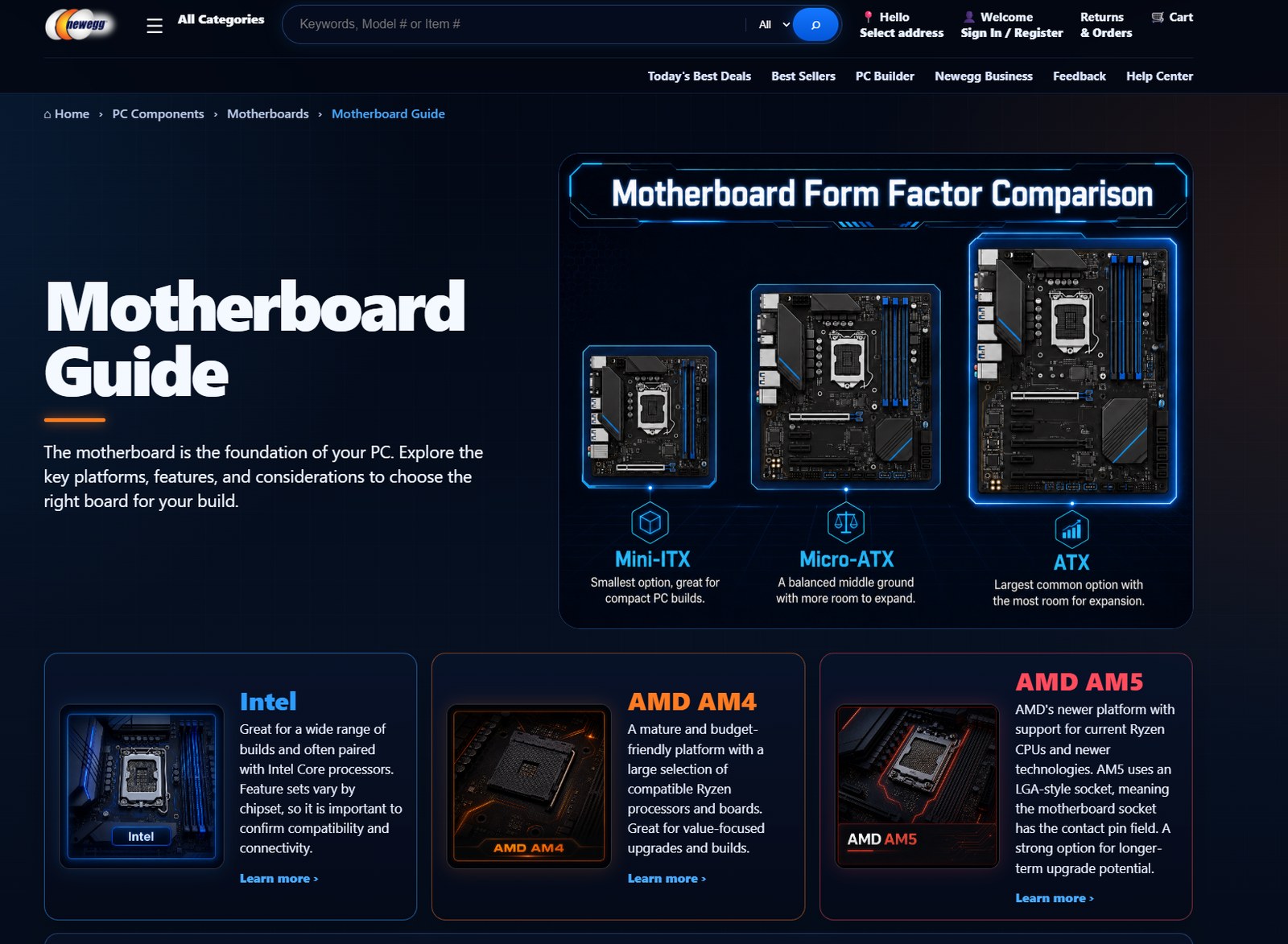
03Hardware Education PagesVisual explainers for GPU VRAM, CPU cores, DDR4 vs DDR5, 60/144/240 Hz, IPS/VA/OLED panels, and Windows editions — heavy on imagery, light on jargon.
04Trade-In ProgramA simplified pop-up flow with dropdown part selection, offer & credit confirmation, and safe-packaging guidance for pricey GPUs.
05Assisted-Sale AttributionA referral-capture prototype linking a support chat to a later order (conversation ID, timestamp, 30-day window) — crediting agents without a sales pitch.
06Internal DemosConcepts presented in discussions on guided shopping, AI-assisted checkout, callback routing, and customer issue reporting.
Before, there was no clear place to send customers for PC help and the information was scattered across product listings, support pages, and manufacturer docs. The concept pulls everything into one hub with several clear entry points:
PC Support hub — one front door to help, with entry points for live chat, a callback, and topic-specific guidance (motherboards, GPUs, CPUs, monitors, Trade-In, Windows editions).Example hardware education page — a visual Motherboard Guide covering form factors (Mini-ITX, Micro-ATX, ATX) and platforms (Intel, AMD AM4/AM5) instead of dense spec sheets.
Iteration: it wasn't one-and-done. An early concept put a "Buy Now" button directly in chat; after stakeholder feedback I removed it and shifted to the lighter-touch attribution approach — recognizing the agent's contribution without pressuring the customer. The result is a clearer, less intimidating support journey: defined entry points, hardware concepts anyone can grasp, a structured callback experience, a simpler trade-in flow, and a real way to credit agent-assisted sales — all drawn from patterns in actual customer cases. The goal was never to replace agents, but to clear up confusion before the conversation starts so they can focus on the hard troubleshooting.
Frontline SupportPC HardwareTroubleshootingUI DesignUX ThinkingWorkflow DesignProcess ImprovementPrototypingStakeholder Communication
Work shown here consists of designs, prototypes, mockups, and internal demonstration materials — not necessarily deployed to Newegg's live production site.
★ Featured Build · Case Study
STUBOT — From Dog-Photo Joke to Self-Hosted AI Assistant
A Python Discord bot that grew into an OpenAI-powered character running 24/7 on a Raspberry Pi 5
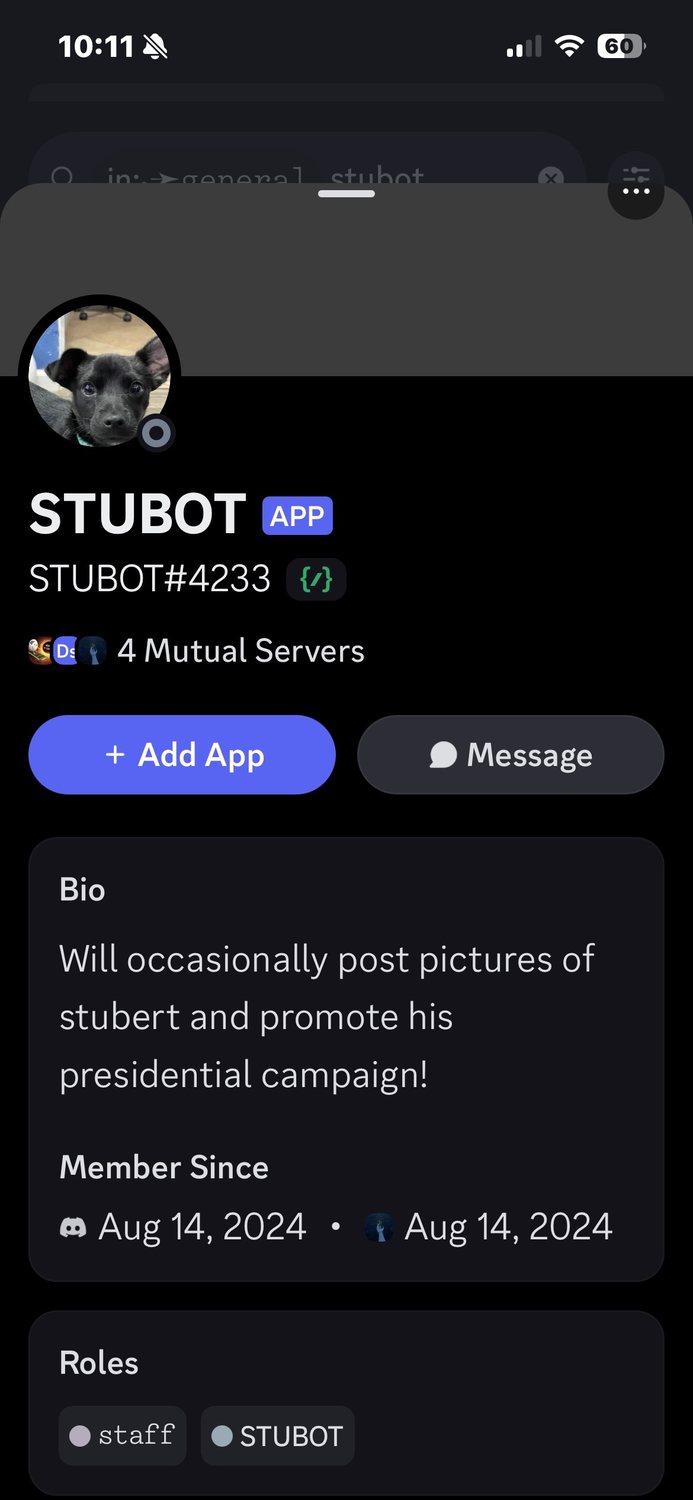
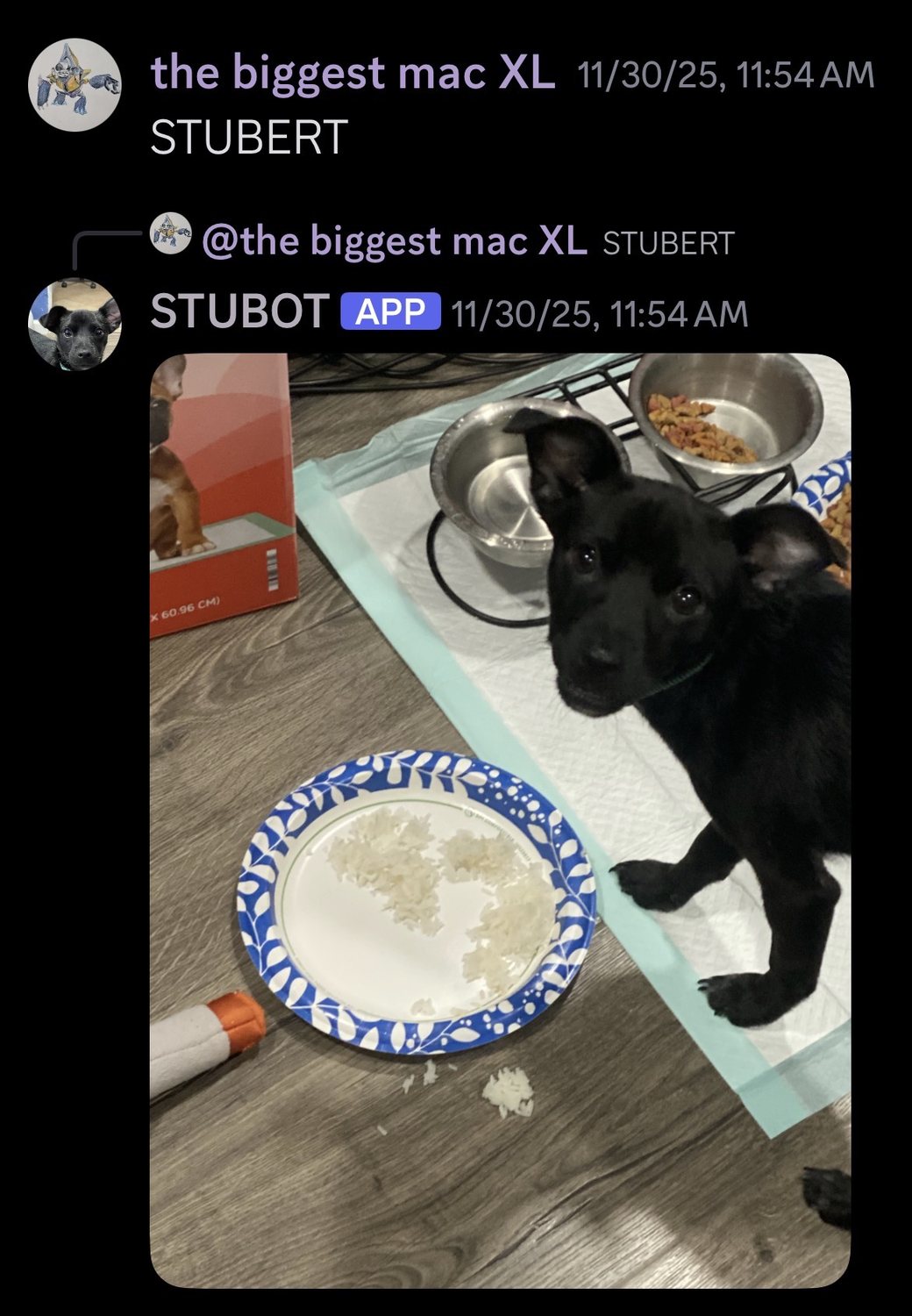
STUBOT started as a joke: type “STUBERT” in Discord and it posts a random photo of my dog, Stuart. That tiny keyword bot became my hands-on way to learn Python — and I never stopped expanding it. It grew commands, a personality, and permissions; became a remote 3D-printer monitor with status, progress, ETA, and live webcam snapshots over Discord; gained real conversation by integrating the OpenAI API; and finally moved off my computer onto a dedicated Raspberry Pi 5 so it runs around the clock without a paid cloud server. Each new thing I learned became another layer.
Discord user → Python on Raspberry Pi 5 → OpenAI API → Discord response
01The JokePosts random photos of my dog Stuart on a keyword
02Python ExerciseEvent handling, files, commands & permissions via the Discord API
03Printer MonitorPrint status, progress, ETA & live webcam snapshots
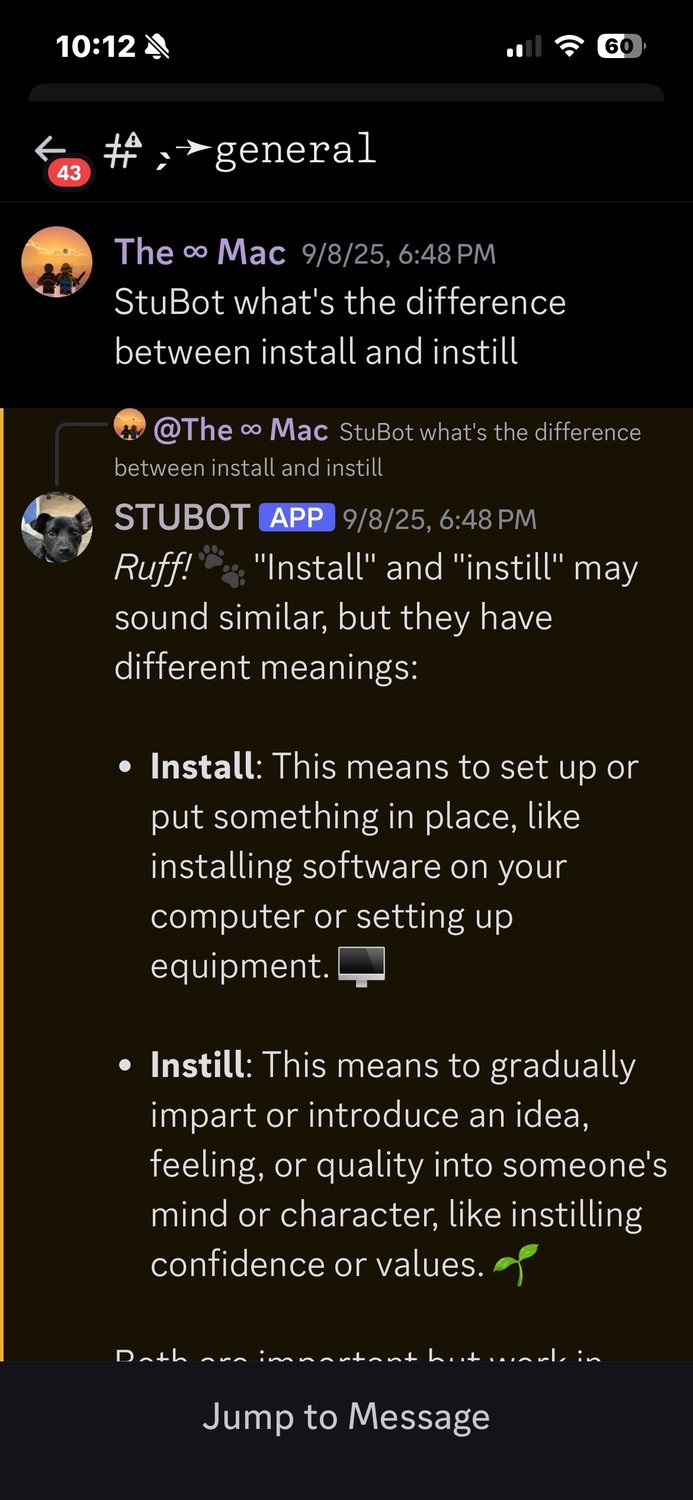
05AI AssistantOpenAI API for open-ended, generated conversation
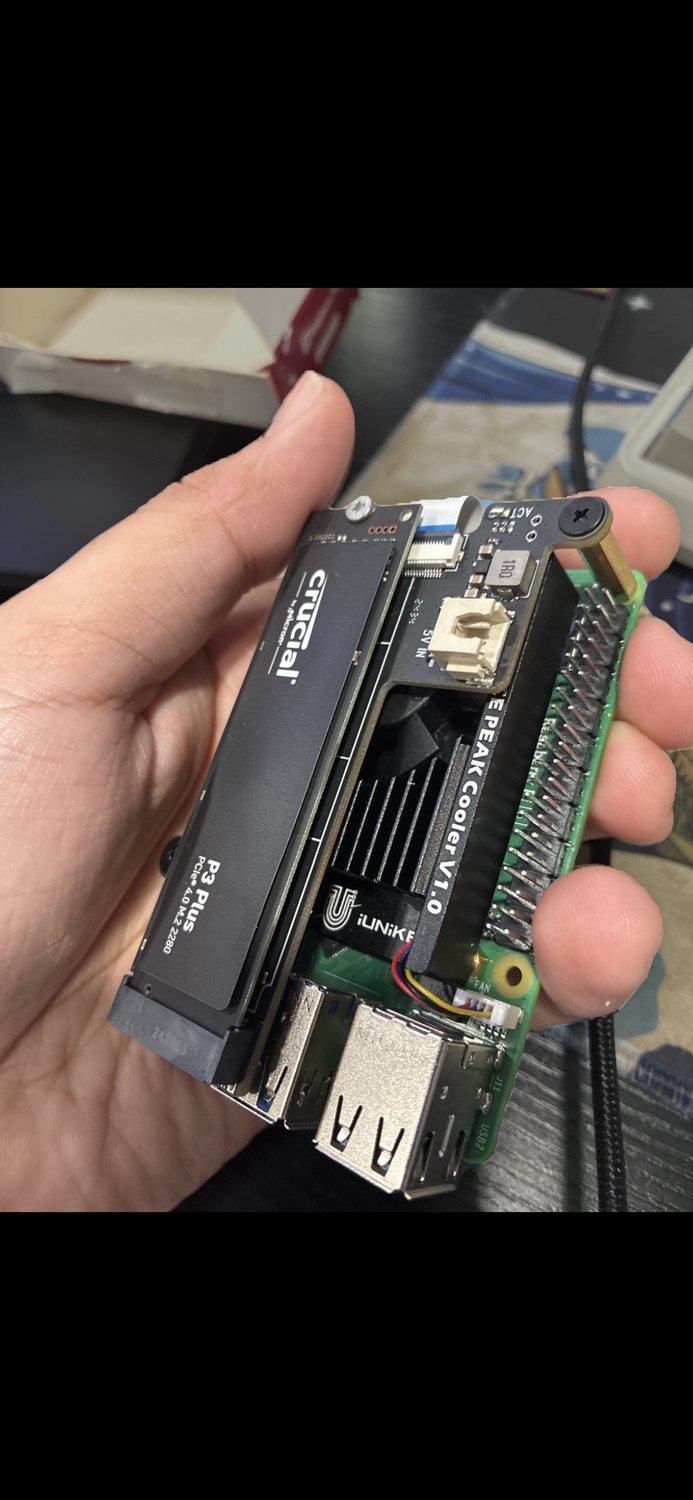
06Self-HostedRuns 24/7 on a dedicated Raspberry Pi 5 with auto-start
STUBOT profileKeyword responseOpenAI-powered replyRaspberry Pi 5 host
PythonDiscord APIOpenAI APIRaspberry Pi 5LinuxWebcam3D-Printer MonitoringAutomation
★ Featured Build · Case Study
Epoch — An AI Planner That Prints My Day
A self-hosted Raspberry Pi 5 system: Claude plans my day, a printer delivers it at 6:30 AM, and a voice check-in teaches it who I am
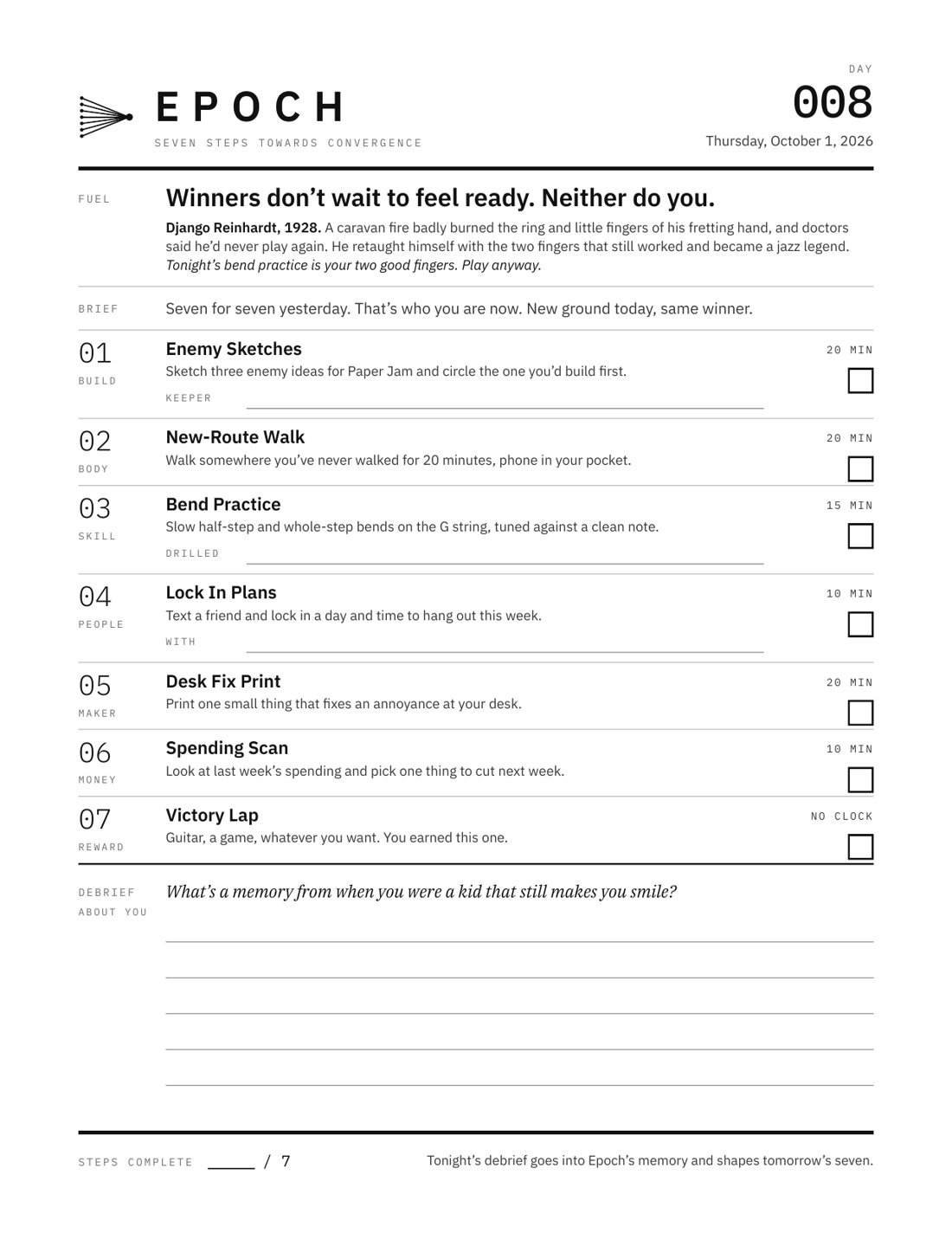
I wanted more structure in my days without adding another app I'd end up ignoring. Paper is hard to ignore, so I built on what I'd learned self-hosting STUBOT: a Raspberry Pi 5, this time wired to a printer. Every morning at 6:30 it prints a one-page sheet called Seven Steps Towards Convergence: a mantra and a short true story to start the day fired up, six fresh tasks pulled from different parts of my life, a Victory Lap reward at the end, and one personal question for the night. Before bed I check in from my phone, tick off what I finished, and answer the question by typing or just talking. Epoch folds my answers into a private memory and writes the next morning's sheet around them, so every sheet fits my life a little better than the last.
Voice check-in → Whisper on the Pi → Claude API (memory + plan) → HTML/CSS → PDF → printer at 6:30 AM
01The SheetMantra, true story, seven steps and a question, fitted to one printed page
02Always NewSix different areas of life each day; no task repeats for three weeks
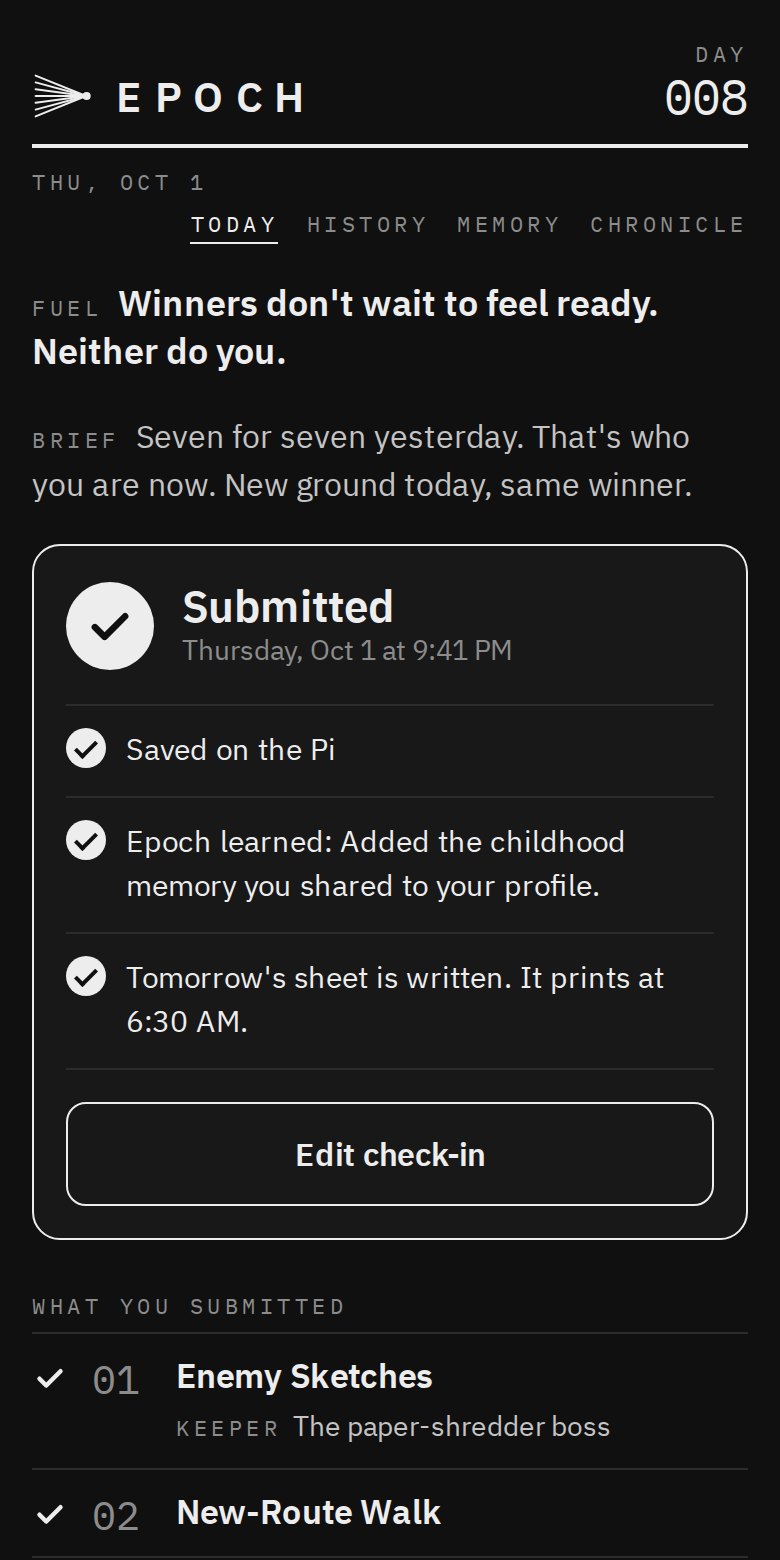
03Check-InPasscode-protected phone page with a mic on every box and a live “Submitted” receipt
04Private VoiceSpeech-to-text runs on the Pi itself; recordings are deleted right after
05MemoryA private profile Claude updates each night, so every sheet knows me better
06Never MissesRetries, an offline edition and timers that catch up after a power outage
A printed daily sheetThe evening check-in on my phone
How I built it: I ran it like a product, with myself as the first user. The hardware came first: moving the Pi to boot from an NVMe drive, getting an older HP inkjet printing over USB with driverless IPP, and serving the check-in page over HTTPS with the Pi's own certificate authority so my iPhone would allow the microphone. Python ties it all together. Claude returns structured JSON that has to pass validation before anything prints, WeasyPrint turns HTML and CSS into the printed page, and systemd timers run the schedule, all for a few dollars a month in API costs. Then I iterated from daily use. When the steps started to feel repetitive, I made them new every day. When typing on my phone felt like friction, I added voice to every field. When I wanted more motivation, the morning mantra became a coach that talks to me like a winner. Everything lives on the Pi; the only data that leaves the house is what's sent to the AI APIs.
AI as a power tool: I built Epoch with Claude as my AI pair programmer. I owned the product: the vision, the requirements, and the decisions about how it looks, feels and behaves. I set up and debugged the hardware, tested each change on real paper, and backed the code with automated tests that simulate the AI, the microphone and the printer, plus browser tests on a phone-sized screen.
What it shows: When I see a real need, I build the whole thing: hardware, software, design, and the unglamorous reliability work that lets it run every single morning without me touching it. I design for the person actually using it, and I keep improving from honest feedback, including my own.
PythonRaspberry Pi 5Linux · systemdClaude APIPrompt EngineeringFlaskHTML/CSS Print DesignWeasyPrintCUPS · IPPWhisper (on-device)HTTPS · Local CAAutomated TestingAI-Assisted Development
★ Featured Build · Made With Love
The Cheli Chronicle — A Newspaper With One Reader
Every Saturday at 9 AM, Epoch prints a two-sided newspaper for my girlfriend: a royal proclamation, puzzles, and a picture to color
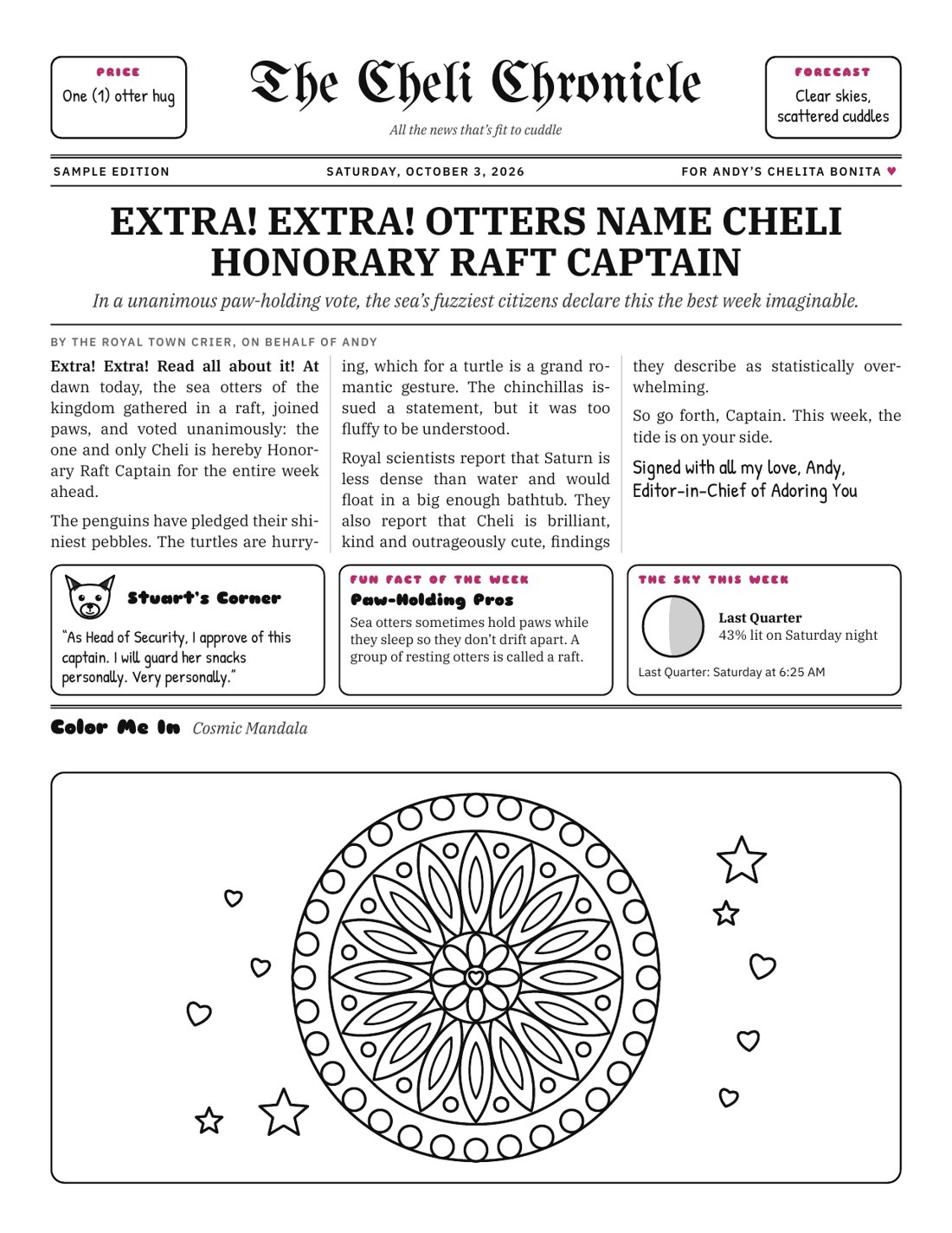
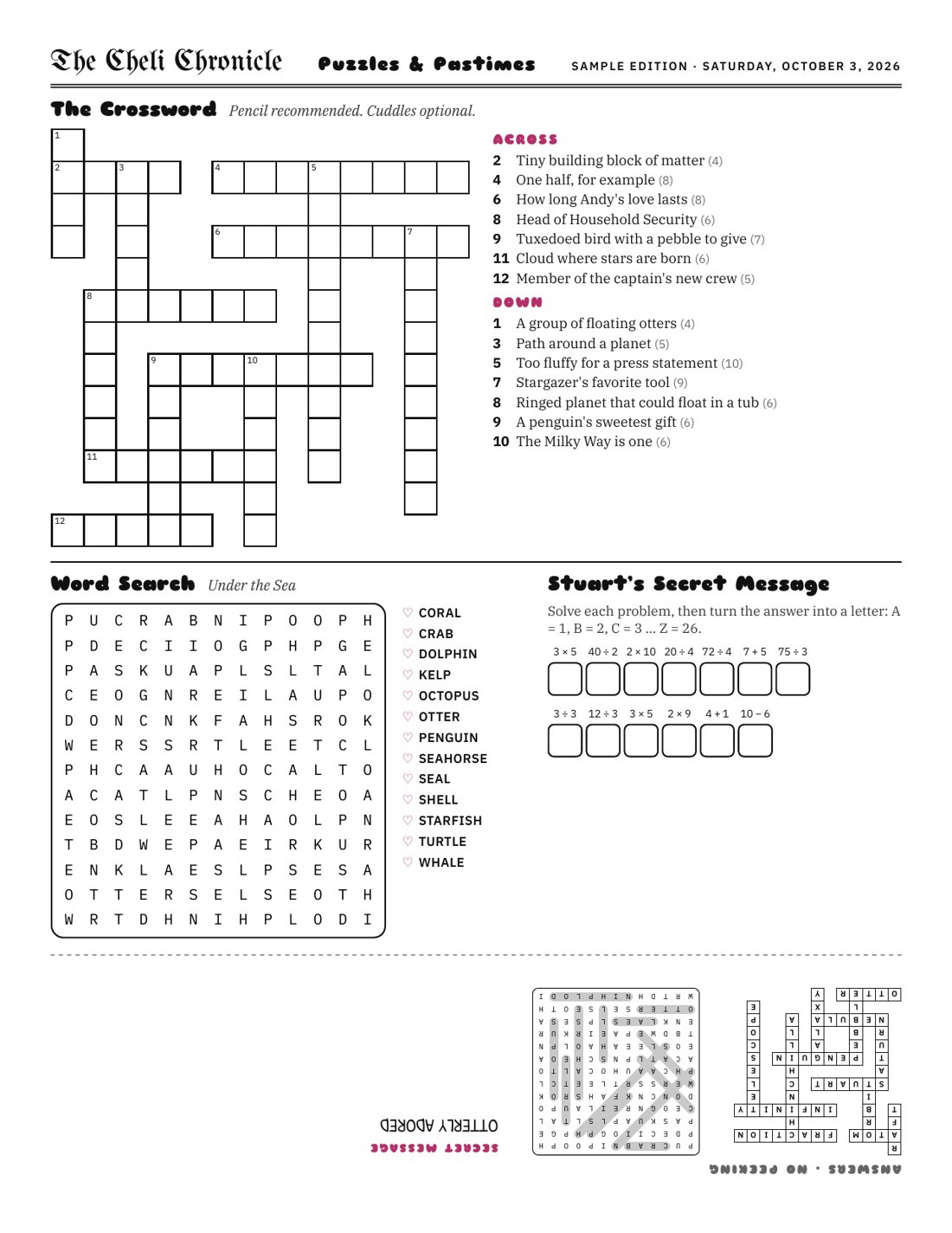
Once Epoch was running, I wanted the same Pi to do something for someone I love. The Cheli Chronicle is a weekly newspaper made for an audience of one. The front page opens with an over-the-top “Hear ye, hear ye!” proclamation declaring her week the best one imaginable, packed with the things she loves: otters, penguins, turtles, chinchillas, space, math and science. Stuart, our chihuahua, weighs in from Stuart's Corner as Head of Household Security. There's a fun fact, the real moon phase for the week, and a big picture to color. The back has a crossword, a word search, and a secret message where every letter is a small math problem, with the answers printed upside down at the bottom.
Claude writes it → puzzles built & verified → OpenAI draws the art → HTML/CSS layout → two-sided print, Sat 9 AM
01The ProclamationA new “Hear ye!” story every week; themes and facts never repeat from recent issues
02Puzzle EngineCustom crossword, word-search and math-cipher generators; every answer key is checked
03Color Me InOpenAI draws a new scene, cleaned into crisp line art, with built-in drawings as a backup
04The Real SkyMoon phases calculated on the Pi with Meeus's astronomical algorithms, accurate to within a minute
05Notes for HerA web page where I add notes about her week, by voice too, and the next issue works them in
06Always ArrivesA backup edition prints if the AI can't be reached, so Saturday's paper always shows up
Front: the proclamation and a picture to colorBack: crossword, word search and secret code
How I built it: Claude writes the words, but the puzzles come from custom code, not the AI, so they're always solvable: a crossword engine that fits the week's answers into an interlocking grid and numbers the clues, a word-search generator, and a cipher that turns a sweet message into simple math. Each puzzle is checked against its answer key before it can print. The coloring page comes from OpenAI's image model and is cleaned into high-contrast line art with Pillow, with automatic fallbacks if a model is unavailable. Two-sided layout, Saturday scheduling, a one-tap test print and a web page for my notes all plug into the same Epoch system. Like Epoch, I built it with Claude as my AI pair programmer.
What it shows: Technology is at its best when it's personal. I care about the details nobody asked for, like making sure every crossword is solvable and every moon phase is right, and I like using what I know to make the people around me smile.
PythonClaude APIOpenAI Images APIAlgorithmsPuzzle GenerationPillowPrint DesignDuplex PrintingRaspberry Pi 5Creative Coding
The issue shown is a sample that uses one of the built-in drawings. Real issues get a new AI-drawn coloring page every week.
★ Featured Build · Case Study
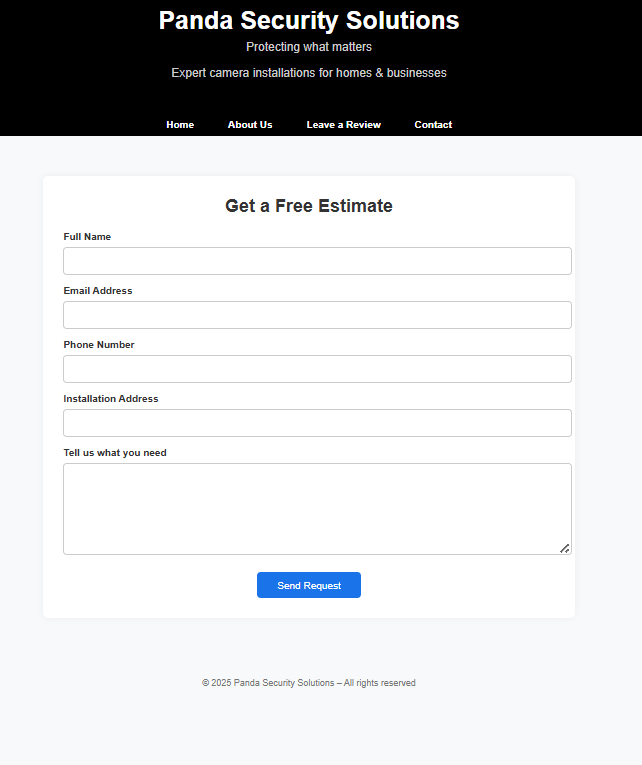
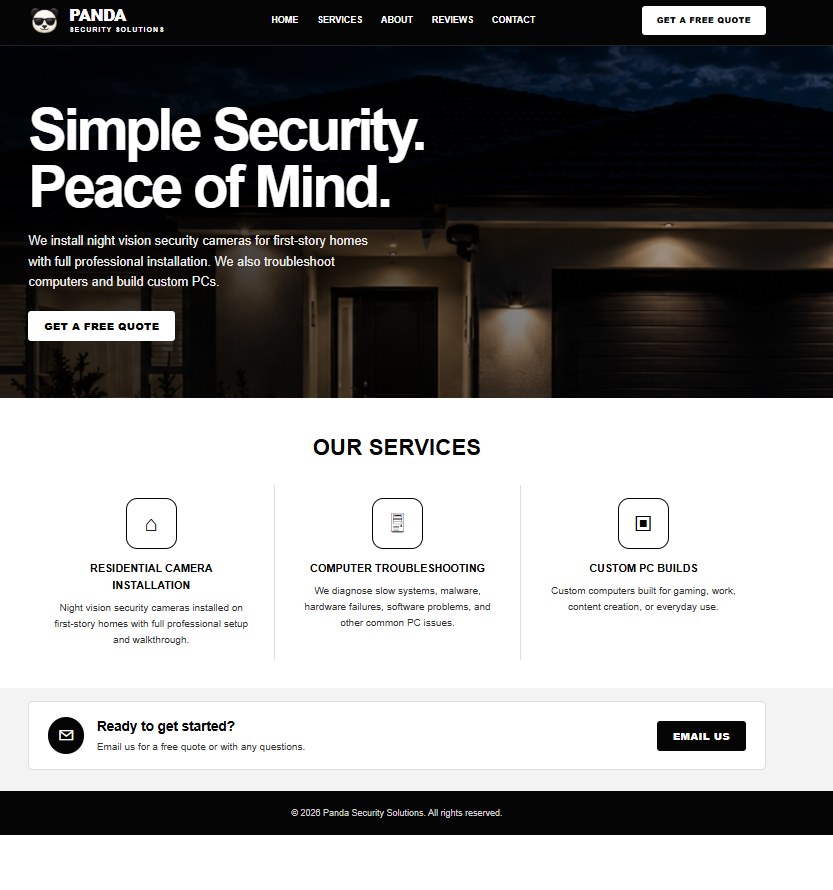
Panda Security Solutions — From a Basic Page to a Cloud Platform
A rebranded small-business site running on serverless AWS infrastructure
Panda Security Solutions is my own small-business concept — residential security-camera installation, computer troubleshooting, and custom PC builds. I rebuilt its website from a basic page into a modern, professional platform: a clean black-and-white panda brand, a clear service layout, and a customer journey that ends in a quote form. Behind the scenes it runs fully serverless on AWS, so submissions are captured and stored without a traditional web server ever running. The hard part wasn't the visual redesign — it was modernizing the front end without breaking the live back end that processes real customer leads.
Customer submits form → API Gateway → Lambda → DynamoDB · hosted on S3 + CloudFront
S3StorageHosts the HTML, images, styles & scripts
CloudFrontCDNCaches & delivers the site fast worldwide
API GatewayEndpointSecurely receives form submissions
LambdaComputeProcesses requests with no server to run
An experimental, fully AI-integrated bilateral projection device — a custom embedded-systems build combining microcontrollers, OLED displays, and 3D-printed housing.
EmbeddedArduino3D Printing
RM Solutions
Custom PC builds and repairs for friends, family, and customers — spec'ing parts, diagnosing failures, and tuning systems for performance and reliability.
PC BuildingHardwareRepair
3D Printing & Prototyping
Designing and printing functional parts, enclosures, and prototypes — turning ideas into physical hardware for embedded and repair projects.
3D PrintingCADPrototyping
05 — Contact
Let's build something
Got a role, a project, or a problem that needs solving? I'd love to hear from you.